



- Where rigorous reporting becomes real-world change
For the first time, the Pulitzer Center is mapping how journalists and newsrooms around the world actually approach impact.
The Pulitzer Center believes in the power of stories to facilitate real-world change. We place impact and audiences at the heart of our work, advancing an approach that helps people make sense of a complex world and their role within it. The Impact Initiative helps journalists carry their reporting beyond the page and into classrooms, community halls, photo exhibitions, and the everyday conversations where change begins. We do this through grantmaking, capacity building, and knowledge sharing.
“Impact in Journalism: A Global Report on Current Practices, Challenges and Emerging Trends” was developed as part of the Pulitzer Center’s Impact Initiative to explore how journalists, editors, and media organizations think about impact, the degree to which impact strategies are part of their work, and what opportunities exist to advance impact thinking in journalism.

Journalism as a framework for connection
Our strategic framework places impact and audiences at the heart of everything we do. The Impact Initiative grows directly from that vision: journalism that extends beyond publication, powered by the Pulitzer Center.
This matters now because the ground has shifted. Journalists are working against declining trust, growing news avoidance, and audiences turning to content creators—all while AI reshapes how information reaches the public. Our global survey found a shared belief in journalism's power to create change, but few of the systems needed to deliver it.
Breakthrough Journalism closes that gap, combining quality reporting with storytelling that meets audiences where they are and creates the conditions for civic dialogue, collaboration, and solution-building.
"This process confirmed that impact strategy can't be designed post-production. Integrating it from the beginning has allowed us to forge partnerships, plan distribution in the Tikuna language, and align content with intercultural health goals."

Manuela Saldarriaga Hernández
Pulitzer Center Impact Initiative Fellow, Colombia
How we design for impact
The 30 reporting projects in this first cohort span four continents and nearly every format—TV and FM radio, documentaries, podcasts, social video, and print. Every project started with an Impact Journey, a practical roadmap that helps connect the reporting to the audiences it seeks to serve. Through this tool, journalists reflect on who their audiences are, how they interact with the information around them, and how their stories can best reach and engage them. This is how the Impact Initiative builds on the Pulitzer Center's proven impact tracks.
In practice, it can take many forms. It's a team in the Colombian Amazon turning its reporting on Indigenous youth into mobile-first animated short films in the Tikuna language. It's journalists in India dubbing their films into five regional languages spoken by roughly 72% of the country, so the reporting reaches the people it's about. It’s a traveling photo exhibition moving through three provinces of Argentina, paired with panel discussions and street-art collaborations.

Empowering newsrooms
practical blueprints and impact tools for newsrooms and freelance reporters around the world

Advancing solutions on critical topics
strengthening journalism's role as a resource for building knowledge and informing public debate

Driving community engagement
ensuring quality reporting reaches the communities that need it most and serves as a catalyst for civic dialogue

Inspiring the next generation
sparking curiosity and critical thinking in students, our future leaders, and readers
"Reporting that once attracted hostility became more widely accepted when communicated simultaneously by many contributors. The sense of shared ownership helped dilute attacks and increased the legitimacy of the issue in public discussion."

Ahmad Arif
Pulitzer Center Impact Initiative Fellow, Indonesia
.avif)
KEY FINDINGS
What we're learning about impact
“Impact in Journalism: A Global Report on Current Practices, Challenges and Emerging Trends” is the Pulitzer Center's first effort to map how journalists and newsrooms around the world actually approach impact. We surveyed 273 journalists across 51 countries — newsroom leaders, reporters, audience and engagement editors, and freelancers — to learn how widespread impact work is, what it looks like in practice, where it breaks down, and what support would help most.
The most pressing finding: Journalists strongly believe their work should do more than inform and have the will to connect with their communities, but not the infrastructure to do it. Newsrooms often lack the roles, frameworks, and measurement tools to make that vision systematic.
Reach and engagement remain the most common measures of value; impact is tracked less often, leaving much of journalism's real-world contribution undocumented. 68% of newsroom staff always measure reach and 58% measure engagement, but fewer than half (42%) track impact.
91% of respondents plan at least one substantive impact-oriented action, and most weigh a story's potential impact early — around 72% at the pitch stage— yet 55% act without any method to guide them.
Just 32% of newsroom staff and 27% of freelancers work from a framework for a story's impact.
While more than 75% of newsrooms have staff dedicated to reach and engagement, only about half have anyone working on impact — and many small and mid-sized newsrooms have none.
A majority of journalists associate impact-oriented work with greater audience trust and stronger relevance.
Behind the Story
This inaugural edition of the Impact Initiative brings together 24 reporting projects from all around the world and a wide range of formats, from TV and FM radio to documentaries, podcasts, social video and print publications. Browse a few highlights below.

Roberto Navia
Navia’s reporting chronicled the political, economic, and illicit threats faced by the Bolivian rainforest and the Indigenous people who live there and guard the land. His Impact Initiative project worked to engage the audiences most crucial to the long-form investigation, and included screenings with Indigenous communities for whom documentary footage can become a tool of resistance; panel conversations with legal and scientific environmental experts designed to build governmental actors’ capacity for informed decisionmaking; and a multimedia public exhibition hosted in partnership with media outlets in order to amplify the work sensitize a broad base.
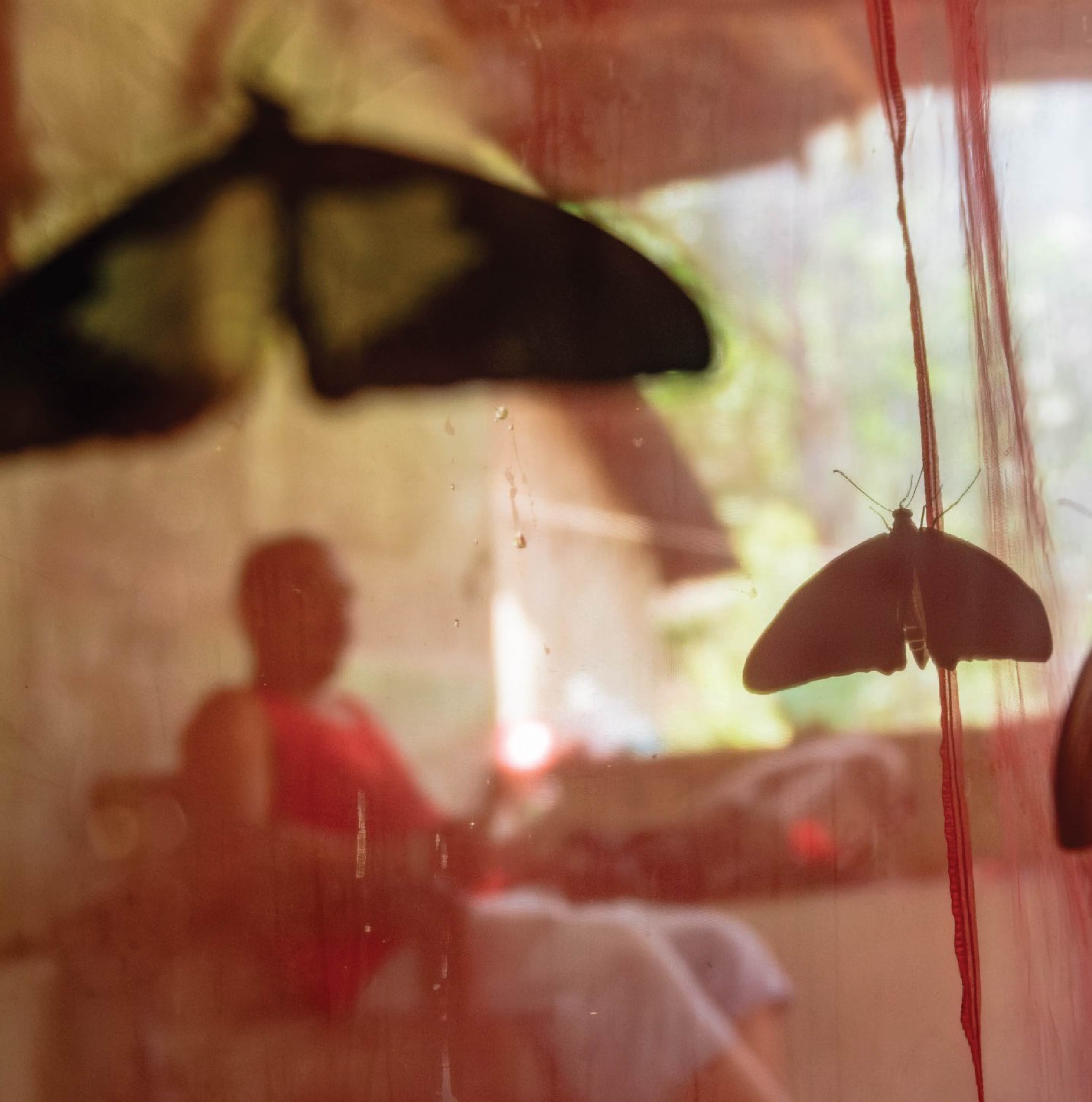
Titah Asmaning
Asmaning’s reporting illuminated the birdwing butterfly’s ecological significance, human threats to their population, and preservation efforts afoot. Her Impact Initiative project brought the purpose and practice of conservation home for Indonesian citydwellers of diverse backgrounds through butterfly observation nature walks and workshops. In collaboration with her participants, she merged journalism, art, and science to produce a “Butterfly Encounters” zine shared digitally and at national literary festivals.

Manuela Saldarriaga
Saldarriaga reported on a suicide epidemic within Indigenous communities in the Colombian Amazon, and the systemic barriers to health resources and culturally appropriate care exacerbating it. Through her Impact Initiative project, she returned the project to the communities she reported on by producing animated shorts in Tikuna and orchestrating a social media campaign in partnership with Indigenous organizations, educators, and media outlets.
"With the guidance and support of our Engagement team, as well as our partner Jazmín Acuña, each of these projects will strategize and design an impact journey to identify who their audiences are, how they interact with the information around them, and how these stories can best reach and engage them."

Flora Pereira
Pulitzer Center Chief Impact Officer
Meet the Pulitzer Center team behind the Impact Initiative


Jonatan Rodríguez
Program Manager, Outreach Latin America & IEO Digital Campaigns


Meet the full Pulitzer Center staff

About the Pulitzer Center
For 20 years, the Pulitzer Center has supported breakthrough journalism that helps people make sense of the world and their place in it. From the earliest days of our work to today, we’ve believed that powerful stories do more than inform: They build understanding, spark curiosity, and inspire action. Across continents and communities, we’ve partnered with journalists to bring underreported issues to light and connect those stories to classrooms, public forums, and decision-making spaces where they can drive real change.
.jpeg)